+91-9008002536
contact@zenigmalabs.comHow the Intelligence Layer Works
How the Intelligence Layer Works
How AI agents use connected business data, workflows and rules to support day-to-day business decisions and actions.
The Intelligence Layer sits on top of the Enterprise Operating System. It connects relevant business context to specialised AI agents that monitor information, identify what needs attention, prepare useful outputs and support people in taking action.
From Business Data to Business Action
01
Business Data
Transactions, employee records, sales activity, inventory, documents, workflows and other connected business information.
02
Business Context
Relevant records are brought together based on the business role, process and configured access.
03
Specialised AI Agents
Different agents focus on specific activities such as follow-up, exceptions, monitoring, summaries or workflow support.
04
Analysis & Prioritisation
Agents examine the available context to identify relevant items, patterns, pending work or exceptions.
05
Human Review
People review, approve, modify or act on the information where human judgement is required.
06
Action & Follow-up
The resulting action can move through the existing business workflow, with relevant status and context retained.
One Business Context, Multiple Intelligent Roles
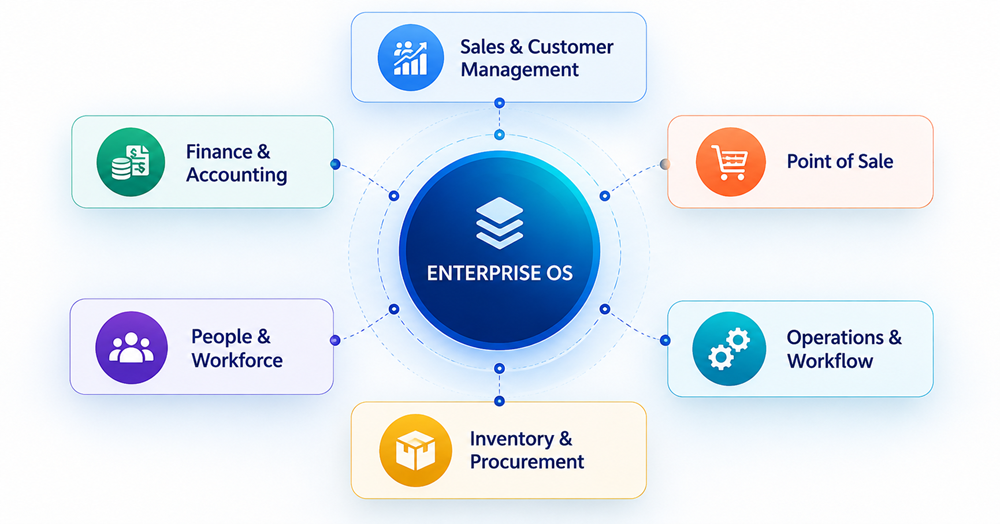
The intelligence layer is not a collection of isolated AI tools. Intelligent HR Manager, Intelligent Sales Manager, Intelligent Procurement Manager, Intelligent Finance Manager and Intelligent Operations Manager can work with the relevant parts of the same connected Enterprise Operating System.
Why Use Specialised AI Agents?
Business processes are different. A finance-related task needs different context from a field-sales follow-up or an inventory replenishment activity. Specialised AI agents allow the Intelligence Layer to focus on the information and workflow relevant to each business role.
Role-specific
Agents operate around a defined business function or activity.
Context-aware
Agents use relevant connected business information instead of working only from a standalone prompt.
Task-oriented
The focus is on useful operational work such as monitoring, identifying, summarising and follow-up.
Connected
Multiple agents can share business context through the underlying Enterprise Operating System.
Human Control Is Built into the Process
The Intelligence Layer is designed to support employees and managers, not remove human responsibility. Businesses can keep approval, judgement, negotiation, customer relationships, statutory responsibilities and other decisions with people.
• Access is based on configured business permissions.
• AI output can be reviewed before a person takes action.
• Business workflows remain the system of record for operational activity.
• People remain accountable for decisions that require human judgement.
More Than a Chatbot
typical AI chatbot
A typical AI chatbot mainly responds to a question.
Intelligence Layer
The Intelligence Layer is designed around business roles and operational workflows. It can work with connected business context to help surface what needs attention, provide relevant information and support follow-up within the business system.
The value comes from combining AI with structured business data, permissions, workflows and operational context.
A Continuous Operating Cycle
The Intelligence Layer can support a recurring cycle across business operations:
Observe
Identify
Prioritise
Review
Act
Follow Up
What the Intelligence Layer Depends On
• Quality and availability of business data.
• Configured workflows, business rules and permissions.
• Relevant connections between business modules.
• Human review for decisions that require business judgement.
See Intelligence Layer in Your Business
Explore how intelligent business roles can work with your existing enterprise operations to reduce routine checking and improve visibility of work that needs attention.